Perspectives in Aseptic Manufacturing: Minimizing Particulate Risk: Designing for Control
Particulate management is a fundamental element of an effective contamination control strategy. Minimizing risk requires attention to both environmental conditions and mechanical interaction.
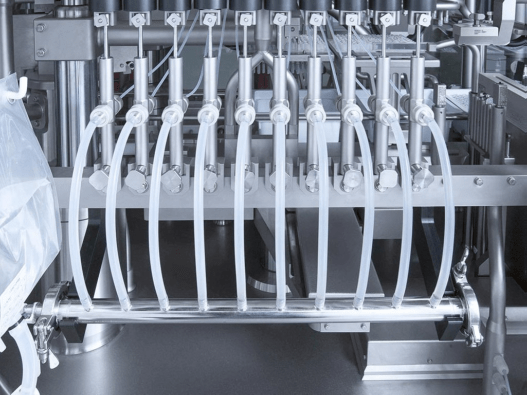
Ten rotary piston pumps. Behind the array of pumps can be seen ready-to-use containers in nest and tub format. Image courtesy of Bausch+Ströbel. Used with permission.
Environmental conditions
Static electricity can attract particulates to container and closure surfaces, interfere with container positioning, and impact in‑process weight measurements. Mitigation strategies include the use of static‑dissipating materials and de‑ionization technologies that are compatible with aseptic environments.
Airflow design is equally important. Properly configured unidirectional airflow should move from critical zones toward less critical zones to limit particulate migration. Separation of unit operations and the use of physical barriers can further reduce cross‑contamination potential. Integrated particle monitoring and alarm systems support rapid response in the event of excursions.
Mechanical interaction
Mechanical transport mechanisms influence particulate generation as well. Conveyor‑based systems may enable higher throughput but introduce friction and abrasion risks. Robotic or hybrid transport systems can reduce container contact surfaces and enable one hundred percent in‑process checks, balancing speed with precision.
Closure handling must also be evaluated. Contact between elastomeric sealing surfaces and vibratory feeding or pick‑and‑place equipment should be assessed to prevent scratches or abrasions that could impact container closure integrity.
Automation in debagging and de‑nesting processes reduces direct human interaction within critical environments and supports Annex 1 contamination control expectations.
Particulate control is not addressed through a single intervention. It is achieved through coordinated design decisions across equipment, materials, airflow, and monitoring.
West partners with customers to assess how packaging components and equipment interfaces influence particulate performance and overall line robustness. If you are evaluating risk within your fill-finish process, we can help you identify opportunities for greater control.
Need help selecting the right packaging components for your fill-finish line? Connect with our experts.


 English
 Chinese